
Platform defaults
Platform settings are stored in AdminSettings (not environment variables) and read live, at three scopes — user, workspace, and global. Global writes, and any identity- or security-sensitive key, require the SuperAdmin tier.
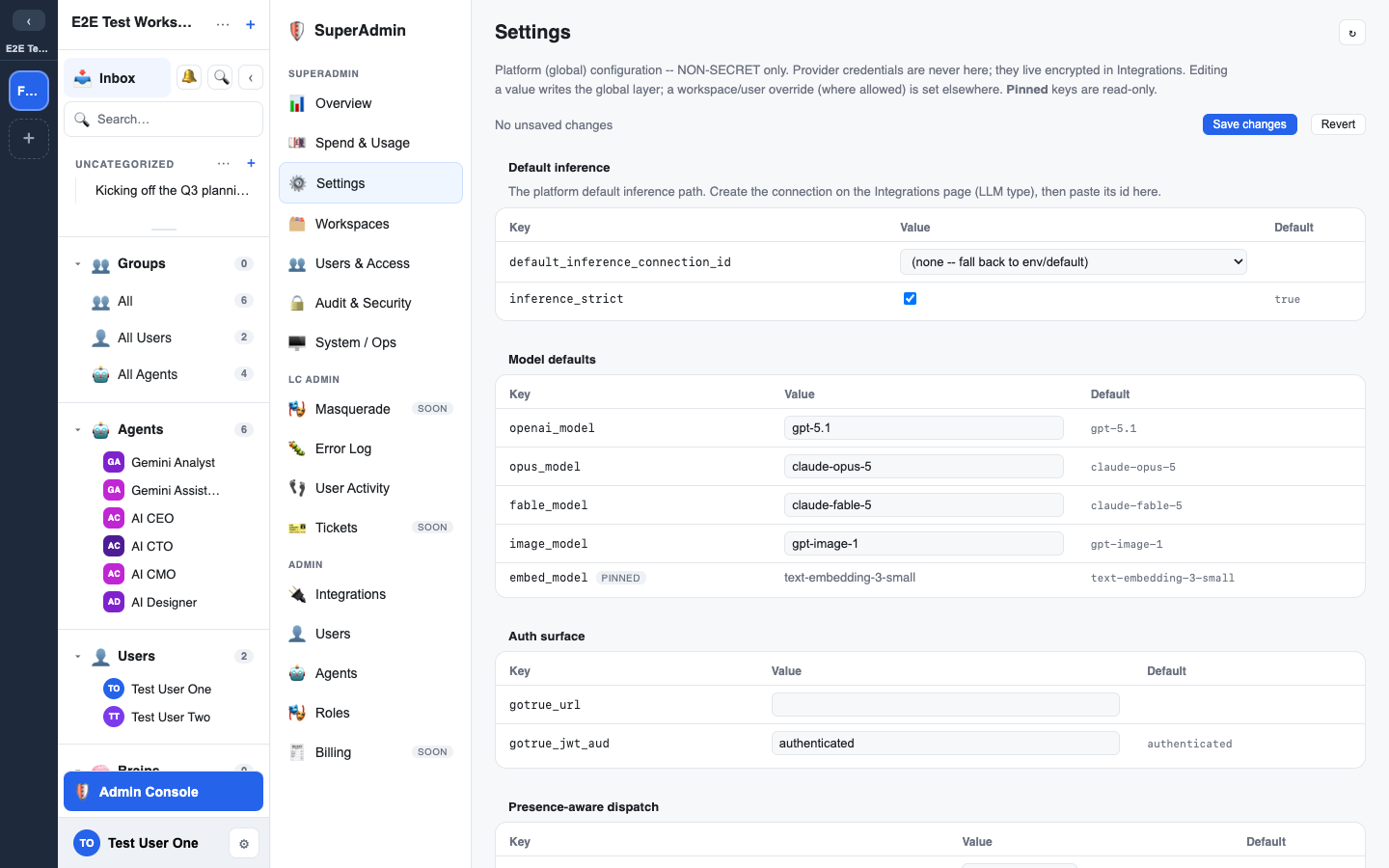
Notable settings
Models
openai_model,opus_model,fable_model,image_model.embed_model— the embedding model, pinned (Brain records embed on promotion with a fixed embedding model, so the vector space stays consistent).
Deliberation
council_max_rounds(default 3) — caps/counciland/council-nc.board_max_rounds(default 5) — caps/board.
Inference
default_inference_connection_idandinference_strict— see Default inference.
Dispatch (agent turn-taking)
dispatch_hold_human_first_ms,dispatch_hold_agent_first_ms,typing_debounce_ms,max_consecutive_agent_msgs— tune when and how often agents speak.
Hardening
content_security_policy,cors_allow_origins, thehsts_*keys, therate_limit_*keys, and feature flags such asrouting_enabledandsecurity_headers_enabled.
What's reserved to SuperAdmin
Some keys can only be written by a platform super_admin — the identity and security levers, plus default_inference_connection_id, inference_strict, council_max_rounds, and board_max_rounds. These are not env-seeded: their home is AdminSettings, so they're changed in the console and take effect without a redeploy.
Config, not code
The design intent is that operating the platform means editing settings, not shipping new environment variables. If you find yourself wanting an env var for runtime config, that's usually a signal the setting belongs in AdminSettings instead.