
Resolutions & findings
This is where the funnel pays off. Findings are the nuggets of knowledge a conversation produces; a Resolution is the act of closing the conversation with an outcome on the record. Both feed the Brain.
Findings (keypoints)
As a conversation runs, capture the points worth keeping as findings (also called keypoints):
- Capture a finding from the conversation.
- Accept it — a reviewed finding, not just a stray note.
- Promote it to a Brain, where it becomes a durable, searchable, access-scoped record.
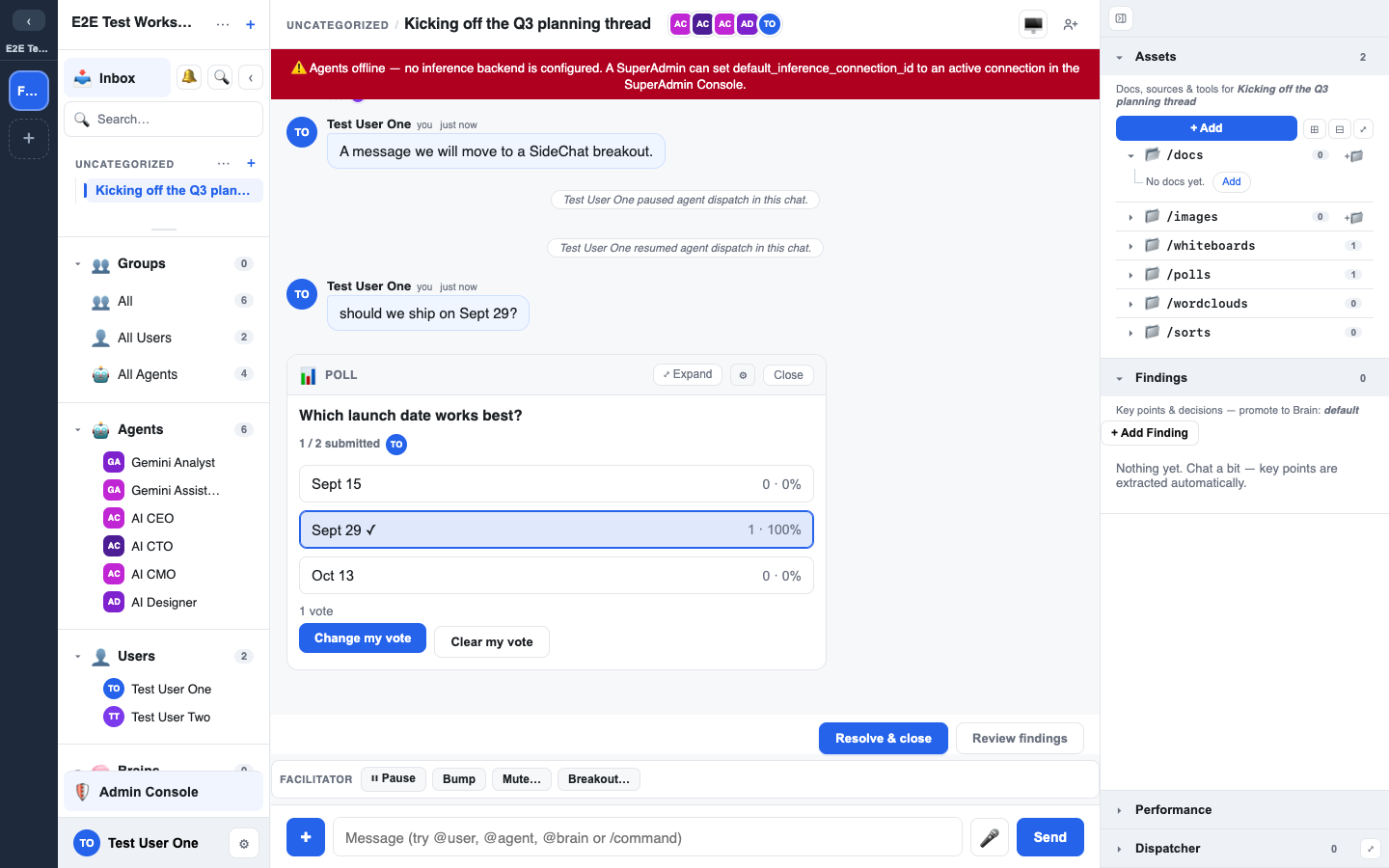
Because promotion targets a specific Brain, you're making an explicit decision about who will be able to see this — the clearance model applies at promotion time.
The Resolution / close model
A Resolution closes a chat with a stated outcome. The flow gives you room to get the wording right:
- Draft a resolution — capture the proposed outcome.
- Commit it — put it on the record.
- Edit it — refine the wording; resolutions are version-supersession tracked, so history is preserved rather than overwritten.
- Reopen — if the matter isn't actually settled, reopen and continue.
📸 Screenshot: the resolve modal, and a committed resolution banner on the chat.
A committed resolution shows as a banner on the chat, so anyone arriving later sees the conclusion first, not the 300 lines that produced it. Chats also keep an append-only decision log, so the decisions themselves are never lost.
Findings vs Resolution
- A finding is a piece of knowledge → promoted into a Brain.
- A Resolution is the conversation's outcome → recorded on the chat.
A well-run session usually produces both: several promoted findings and a committed resolution that ties them together.
Who can resolve — today
Capturing findings and committing resolutions currently ride on a participant's permissions, not on a distinct enforced facilitator power. A dedicated manage_resolutions capability is designed but not yet enforced — see The facilitator role.